


Book Club Discussion Questions: Playground by Richard Powers

For those of you that haven't or couldn't attend book club lately, we're publishing this months' discussion questions here. All previous book club selections have been posted, complete with summary, discussion questions and, when necessary or appropriate, additional resources to better understand the topic or context. Here are the questions from our current title, Playground. We hope these questions spark discussions of your own.
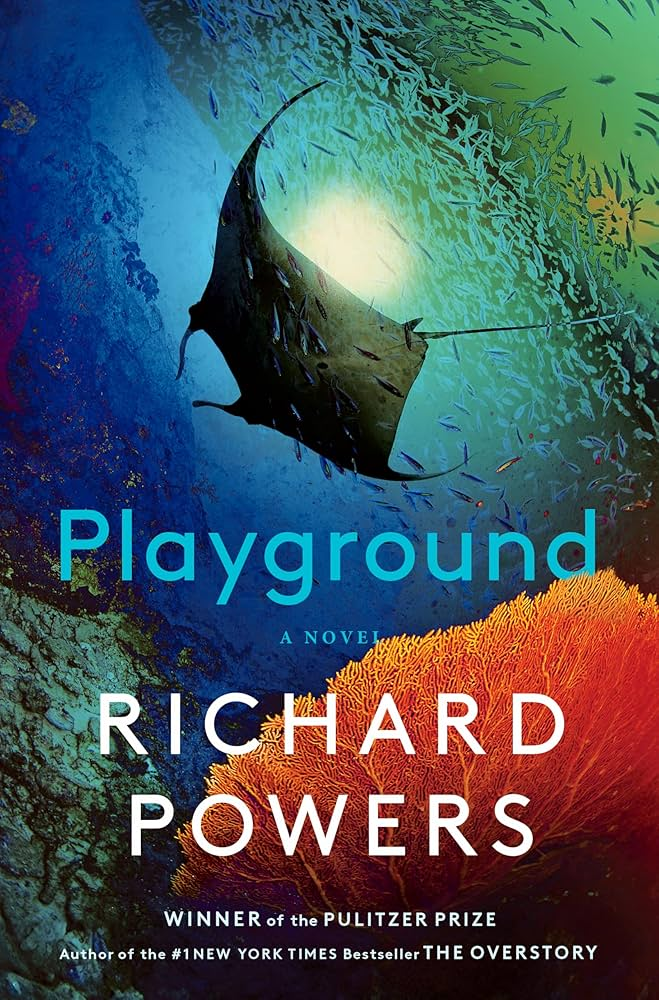
Playground
by Richard Powers
Summary:
New York Times Bestseller
Finalist for the 2024 Kirkus Prize
Longlisted for the 2024 Booker Prize
As Seen on CBS Saturday Morning
A New York Times Book Review Editors' Choice
One of the Ten Best Books of 2024, according to the Washington Post and AARP
A Time Must-Read Book of 2024
One of NPR's "Books We Love" for 2024
An Economist, The New Yorker, and Kirkus Reviews Best Book of 2024
Selected as Fall 2024 "Fiction to Read" by the New York Times, Los Angeles Times, Chicago Tribune, People, and Parade
A magisterial new novel from the Pulitzer Prize–winning and New York Times best-selling author of The Overstory and Bewilderment.
Four lives are drawn together in a sweeping, panoramic new novel from Richard Powers, showcasing the Pulitzer Prize–winning author of The Overstory at the height of his skills. Twelve-year-old Evie Beaulieu sinks to the bottom of a swimming pool in Montreal strapped to one of the world’s first aqualungs. Ina Aroita grows up on naval bases across the Pacific with art as her only home. Two polar opposites at an elite Chicago high school bond over a three-thousand-year-old board game; Rafi Young will get lost in literature, while Todd Keane’s work will lead to a startling AI breakthrough.
They meet on the history-scarred island of Makatea in French Polynesia, whose deposits of phosphorus once helped to feed the world. Now the tiny atoll has been chosen for humanity’s next adventure: a plan to send floating, autonomous cities out onto the open sea. But first, the island’s residents must vote to greenlight the project or turn the seasteaders away.
Set in the world’s largest ocean, this awe-filled book explores that last wild place we have yet to colonize in a still-unfolding oceanic game, and interweaves beautiful writing, rich characterization, profound themes of technology and the environment, and a deep exploration of our shared humanity in a way only Richard Powers can. -- Publisher Description
Discussion Questions
1. What did you think of the relationship between Rafi and Todd? How are they alike? How are they different? Did you take a side in their long-running match? Was reconciliation and forgiveness ever possible?
2. Why was the marine biologist story included? What did she pull into the story? What was the most compelling imagery about oceans? Could a movie ever do it justice?
3. Why was this Polynesian island chosen as a setting? How is it a refuge? What does it represent about humanity’s relationship with oceans? What does the vote of the island symbolize? Did it make you look different at land use and ocean usage? Did it make you think differently about who should get a vote in a democratic society?
4. At what point did you realize the story of Rafi, Todd and Ina and the island and the vote were all being created by an AI tool that Todd had created and “planted” through with his memories? Did the realization that the author is the AI anger or disappoint you? Why would you feel disappointed — this is after-all one big work of fiction anyways?
5. Playground has a complex narrative that interweaves topics including technology, environmentalism, memory, and loss. Which aspect of the novel affected you most deeply, and why?
6. In what ways does Playground compare to Powers’s Pulitzer Prize-winning The Overstory, particularly in its exploration of environmental themes and human connection? Does it remind you of other recent novels that address similar issues?
7. The novel uses a nonlinear narrative structure that intersperses Todd’s first-person memories throughout a broader third-person story that the novel later reveals is AI-generated. How did this approach and revelation affect your reading experience?
8. Playing games like chess and Go is central to Todd and Rafi’s friendship. Have competitive activities ever played a role in your important relationships?
9. Rafi and Todd both carry guilt. Have you ever felt guilty about something, and did that guilt influence your decisions in any way?
10. Todd suffers cognitive decline while creating AI with God-like creation powers and seems to be pursuing the “Common Task.” What do memory, creation, intelligence, and death have in common? Powers says “Death is the mother of beauty.” Where do you see examples of this in the book? If this phrase is true, why would we want to overcome death?
11. How does the emergence of deep seek and its logo of the whale make you think about deep learning and deep oceans?
12. How does the creation and work of DOGE make you feel about the value of work on society’s behalf? Does Todd remind you of Elon Musk or of other tech billionaires and if so, does that make you more sympathetic to them or less?
13. What will destroy humanity first: AI or Climate Change? Did you leave this book feeling we are doomed or feeling hopeful for human’s future? Can philanthropy and projects from the super-rich make the world a better place or are they in fact just accelerating our doom from ai and climate change?
14. What different types of “intelligence” show in the book? Think of humans, think of marine life, think of artificial intelligence.
15. What makes humans human? Is it intelligence? Is it emotions — love, friendship, forgiveness, delight? Is it creativity? Is it art? Is it our curiosity? Is it our ability to play?
16. The title of the book is Playground and we see the term play coming up many times: as a manta ray plays hide and seek with a diver, as two friends play chess and go, as three friends attend a Shakesperean play, as islanders play ball games, as enemies play out bitter feuds. What does play have to do with learning and intelligence? Did the book make you want to “play” more or appreciate forms of play?
17. Did the novel pique your interest in oceans and sea-creatures? In what way will you engage with oceans differently after reading this?
18. The novel ends with Todd sailing on his yacht named the “Children of Men” and a eulogy for him with that as a line in a poem. The poem is about God’s creation, which often feels akin to Todd’s creation of AI, but in the end, after creation he is finding delight playing with the Children of Men. In the end of the novel this computer genius seemed most to want to be with his friends. Do you find that true at your work? At your book club? What does interaction, especially in the same physical space, face-to-face, bring to our lives? Do you delight in playing with the Children of Men? Is there hope for us as humanity to continue to play and delight in each other?
Official Questions
Playground opens with the spellbinding legend of the Tahiti people’s creation god Ta’aroa. Leaning into the magic of mythmaking, Powers tells Ta’aroa’s story in a poetic fashion. Which of Powers’s writerly choices make this opening chapter “poetic” or captivating? How do you think this chapter sets the stage for the novel’s themes and unfolding drama?
Ina Aroita and her seven-year-old daughter Hariti make a sculpture out of natural “treasures” (shells, bits of coral, obsidian) that wash up on the beach of Makatea. When they find a dead bird (“an albatross, dead for a long time”) (p. 7), Ina reaches into its chest and extracts several foreign objects, including bottle caps and a disposable cigarette lighter, to add to the sculpture. How might this mother-daughter sculpture function as a powerful symbol in Playground? How is the bird “an albatross” on Makatea? In what ways does the creation of this sculpture parallel the stories of the other characters in the novel?
Early in Playground, Todd Keane recalls that as a child the twenty-four points on his backgammon board “began to pulse with plans, like kids jockeying for power on a playground” (p. 17). This is one of many instances where Powers uses the analogy of a playground to emphasize key themes in his novel. Where else is “the playground” used analogously? What is the effect in each instance? What questions and afterthoughts did the analogy raise for you as a reader?
Some Pacific Islanders like to say, Every island is a canoe, and every canoe is an island (p. 30). Unpack this saying. How does it capture what happened during the years phosphate mining transformed Makatea? What bearing might it have on the referendum on whether to turn the island into a base for seasteading?
In his personal statement for admission to Saint Ignatius College Prep, Rafi Young writes, “Sadness is the key to loving what you love and to becoming better than you were” (p. 82). Using what you know about Rafi’s childhood, try to explain how Rafi reaches this conclusion. Do you agree with Rafi? What role has sadness played in your own life?
After her involvement in the Tektite II mission, thirty-six-year-old Evie Beaulieu literally dives into a wreck in the lagoons near Truk. Read Adrienne Rich’s poem “Diving into the Wreck,” and then discuss ways in which Evie’s experiences as a diver and life story mirror and/or refract ideas imparted by the speaker of Rich’s poem. To what extent is Evie “alone” in this novel? What does the ocean provide for her?
Todd, who has been diagnosed with dementia with Lewy bodies (DLB), reveals that at times he can still do what his doctor calls “showtiming.” Curiously, as he reflects upon his doctor’s warnings about showtiming, he abruptly shifts to direct address: “Of course, she had no idea about you and me. I can showtime for you, for hours” (p. 139). To whom is Todd speaking? How did your idea of this “you” change over the course of reading the novel? What happened to your understanding of the novel when you discovered who the “you” was, in the last few pages?
At one point, while anticipating “two weeks of life in one submerged spot” with the crew of Tektite II Mission Six, Evie thinks that the ocean will give human beings “something to aspire toward.” She believes that once people can witness the abundance of underwater life and live in the ocean, they will “ache to take care of the place like it was their home” (pp.180–181). Why do you suppose she believes this? Do you agree with her? What do you think makes a person “ache” to take care of a place?
Todd remembers Rafi saying, “You know why I love games? For the same reason I love literature. In a game . . . in a good poem or story? Death is the mother of beauty” (p. 189). What is Rafi trying to communicate through this metaphor connecting games, literature, and life? How does he view the relationship between beauty and death? Can a game or work of literature ever help “raise someone from the dead”?
At an all-island meeting, Roti Turi suggests that if the Americans come to Makatea and implement their seasteading experiment “they won’t be leaving again,” and life on the island “will change in every way.” Recognizing the impact of the seasteading experiment on future generations, Roti moves to “let everyone who can write their own name vote” (p. 200). Is Roti a voice of reason or a fool? Do you agree with her rationale for giving children the vote? Our own children will pay a tremendous price for our inability to address climate change. Would giving younger people the vote make current governments more capable of doing what is needed to prevent future suffering?
College-age Ina tells Rafi and Todd, “Where I come from, the artists came first and all the gods followed” (p. 205). How does Ina’s view of creation compare with prevailing religious traditions on an American college campus in the 1980s? Why do you think Ina makes Todd nervous? Why do you suppose Rafi, on the other hand, finds happiness and solace with Ina? Why might some readers react negatively to the idea of artists creating the gods? Are artists and gods equal in your view?
As voting day approaches, Rafi suggests to Ina that the “folks” on little islands like Makatea are like “the inhabitants of a Dark Ages monastery, keeping literacy alive.” What is Rafi trying to communicate about “literacy” on the atoll? Is he right or wrong? Ina responds, “Maybe most of Makatea doesn’t want to be . . . monks in your monastery” (pp. 210–211). How is Ina interpreting Rafi’s statements? Whose side are you on?
During his “presentation” to Todd and Ina, Rafi shares a few poems. Analyze “Transcript (A Liberated Sonnet).” To what extent is the poem a manifesto? How do line breaks, repetition, diction, syntax, juxtapositions, and irony help Rafi tell his story? In the final line of “Blumenfeld Countergambit,” Rafi’s speaker declares, “Daddy, abuser, I did as told. Thank you” (p. 231). How do you feel about Rafi’s diction here, “Daddy” alongside “abuser”? Does “Thank you” reveal anything about Rafi’s mental and emotional health?
At ten years old, Todd falls in love with Evie’s book Clearly It Is Ocean, the perfect bible for a child who has divined that the “secret” to escaping family strife is finding “some other place to live” (p. 11). Why does the young Todd believe he can “breathe underwater”? What might “breathing underwater” mean to him? Did your sympathy for Todd falter as his childhood revelation about the ocean and its “whole, new, impossible kinds of life” (p. 25) evolve into his vision for seasteading off Makatea?
In Todd’s view, Rafi’s “golden insight” is that “all playing [has] a cost” (p. 251). To what extent do you think Rafi contributes to what Playground becomes? Do Playbucks make Playground more dangerous or destructive? Does “play” mean something different (something “other” than what Evie observes in the ocean) when it’s monetized? What have been the costs and benefits of different kinds of play you’ve engaged in throughout your own life?
Todd reflects on this quote by Aristotle: “Happiness is the settling of the soul into its most appropriate spot” (p. 259). By this standard, who in Playground achieves happiness? Do characters in this novel seem more equipped to find happiness as they age? How might you describe the relationship between experience and happiness? Between happiness and play?
To educate the people of Makatea on the impact of seasteading, the Americans offer the use of Profunda, a deep-learning AI. Would you trust Profunda under the same circumstances? How does AI currently manipulate human thinking and behavior? Is it possible at this point to resist AI? How will AI affect our planet in the future?
When Evie is preparing to write Clearly It Is Ocean, her husband remarks, “Your father threw you into a swimming pool and you sank to the bottom... And you came out as another kind of creature” (p. 316). How does Evie’s experience strapped to her father’s aqualung change her personality as well as her life’s trajectory? Consider the ubiquitous mythological trope of “katabasis,” or transformation by a descent into the underworld. Have you ever emerged from a catastrophic experience “as another kind of creature”?
What does Evie argue with her book’s title Clearly It Is Ocean? How does she illustrate this argument at the end of her book? How does life in the ocean, “forever unfolding, forever exploring, forever tinkering with form” (p. 327), differ from life on land? Does your understanding of existence change when you consider how much of the world lies underneath the surface of oceans? Did you come away from this book thinking differently about Planet Earth?
In a final chapter of Playground, created by Todd’s conversational partner, Rafi and Ina “gasp at the shrunken, hunched parody of their old friend” (p. 365). Todd is feeble and can no longer speak. Why do you think Powers ends his novel here? How did you react to Todd—lonely, dying tech billionaire—facing Rafi and Ina on Makatea? What effect might reading this final chapter have on Todd, the narrator of the “real” story? What do you think this final, fictional, shrunken Todd would have said to Rafi had he been able to use his voice? What would you want him to say?


Comments